1st hour: "End Kratom Addiction - A father who refused
to stay quiet"
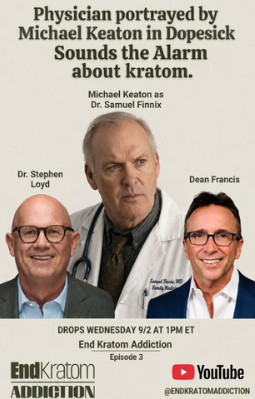
About our guest Dean Francis
Dean
Francis founded End Kratom
Addiction after his son Cameron spent nearly eight years addicted to
a substance he found online, marketed as a safe herbal supplement.
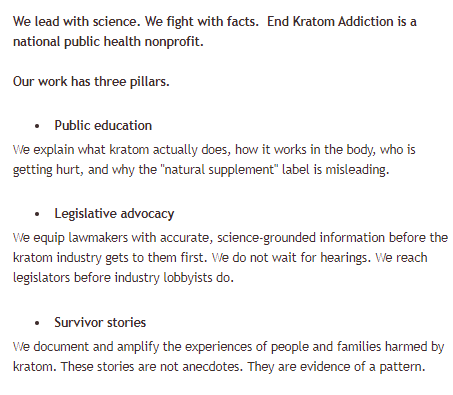
Dean founded End Kratom Addiction after Cameron's addiction and
recovery. He testifies before state legislatures, briefs local
officials, and works with medical and legal professionals to advance
kratom regulation nationwide
Cameron was a college athlete. He was not reckless. He was deceived.
When the family finally got answers, in an emergency room in 2021,
from a physician who explained plainly that kratom acts like an
opioid, they were furious. Not at Cameron. At an industry that had
marketed a dangerous product as harmless, and at a regulatory system
that had allowed it.
Dean started End Kratom Addiction so that no other family would be
blindsided the way his was.
hour 2:"Biden
Blunders Made Drug Price Controls Even
Worse"
The comically misnamed
Inflation Reduction Act imposed
government price controls on
prescription drugs by replacing the old
non-interference principal, which used
market-average prices to set drug
reimbursement, with a scheme that allows the
Secretary of Health and Human Services to
directly set prices via a sham negotiation,
in which the manufacturer has to agree or
face a punitive seizure via a tax equal to
95% of the product’s total sales.
A system like that undermines the return on
the multi-billion-dollar
investment required to develop a new
drug and bring it to market, resulting in
fewer new cures and treatments. It’s a
mistake, and it’s hard to think of how a
policy like that could be made worse. And
yet the Biden administration managed to do
it. They made the price control regime much
worse in practice than it was on paper, and
while the short-term prospects for repealing
the law are dim, the Trump administration
can and should take immediate actions to
reverse several specific Biden blunders.
Former President
Joe Biden’s Center for Medicare and
Medicaid Services, which was tasked with
implementing the scheme, expanded its scope
by ignoring some of the statute’s clear
lines in at least three ways:
First, drugs with
biosimilar (the term for generic biotech
drugs) competition are exempt, because they
already face intense price competition and
because patients and plans that don’t want
to pay for the brand drugs have a ready
alternative. But the Biden CMS ignored
Congressional intent to not disrupt the
strong biosimilar market dynamics in the
U.S. by using the prices of biosimilars as
comparators to justify more stringent price
controls.
Second, Biden’s CMS took words that do
appear in the statute — “therapeutic
alternatives” — and used them, without
meaningful public input, to build an entire
pricing system that appears nowhere in the
statute. They used the pricing of old-style
chemotherapy agents as a benchmark for
cutting-edge complex cancer drugs and other
unrelated therapies. That move justifies
draconian price controls on breakthrough
cures, undermining the incentive to develop
and bring them to market.
Finally, Biden’s CMS also bundled two
insulins approved 17 years apart and called
them one drug to qualify for the minimum
sales threshold and drag them into the price
control regime. Neither product qualified on
its own. This dangerous precedent presents
the risk that nearly any drug could be
dragged into the price control regime via a
bundling back-door, further reducing the
incentive to develop drugs, especially drugs
for rare diseases that would otherwise
target niches narrow enough to escape the
program’s reach.
Aggregate small-molecule investment by
smaller biotech
companies has already fallen by 68%
since the IRA passed. Investment targeting
Medicare-aged populations dropped 74%. The
drugs that will not be developed are the
ones today’s seniors would have used
tomorrow.
It’s mystifying that the Biden team that
drafted and implemented the guidance that
made the so-called Medicare Drug Price
Negotiation Program worse remains largely
intact, while the program they created
remains untouched. A proposed rule released
on June 12 would codify the Biden-era
guidance into law.
President Donald Trump and CMS Administrator
Mehmet Oz should act immediately: Halt Round
3 of price control “negotiations” before
prices are set under Biden-era rules. The
same “program instruction” authority that
the Biden CMS used to build this system
gives the current administration the power
to pause or modify active negotiations. No
statutory change is required. Announce that
Round 4 selections will not move forward
under the old methodology. Modify the
proposed rules to restrict “therapeutic
alternatives” to clinically appropriate,
substitutable drugs only. Restore the
market-based competition criteria and define
qualifying single-source drugs in accordance
with the statute’s plain meaning. Terminate
or reassign Biden-era personnel driving the
program.
To be clear, we don’t think a price control
system can be made beneficial, or even
benign. We support policies that would
encourage more new cures and treatments
while lowering costs to patients. This
includes fundamental FDA reforms to make it
less expensive to bring new drugs to market,
pro-growth tax policies to encourage
investment in new cures, strong global
protection of intellectual property and
American interests, and direct-pay sales
channels as an alternative to opaque
insurer/PBM schemes.
But as long as the IRA is on the books, CMS
must not expand its destructive impact
further, and that starts by getting rid of
Biden policies and personnel.
--Steve Moore is co-founder of Committee to
Unleash Prosperity and an expert on the
intersection of law, economics, and public
policy formation. Phil Kerpen is president
of American Commitment and Principal at
Committee to Unleash Prosperity.
For Interviews:
Stephen Manfredi
Manfredi Strategy Group, LLC
1478 Kirby Road, Suite 1000
McLean, Virginia 22101
202.222.8028 mobile
www.ManfrediStrategyGroup.com


 Dean
Francis founded End Kratom
Addiction after his son Cameron spent nearly eight years addicted to
a substance he found online, marketed as a safe herbal supplement.
Dean founded End Kratom Addiction after Cameron's addiction and
recovery. He testifies before state legislatures, briefs local
officials, and works with medical and legal professionals to advance
kratom regulation nationwide